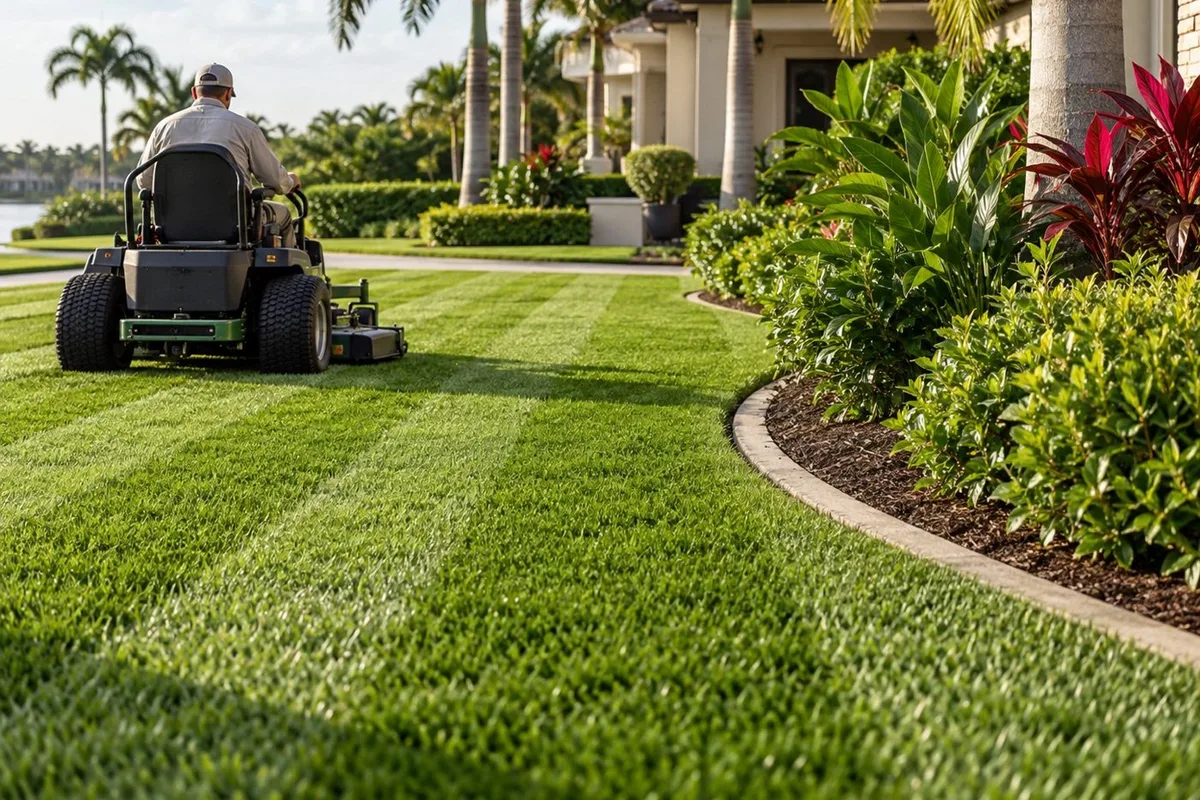
Fall lawn fertilizing in Broward County comes down to timing. Through the summer, many Broward cities prohibit fertilizer containing nitrogen or phosphorus, and the heavy rains of that season would wash much of it away anyway. By November those restrictions have ended for the year, and lawns that went months without a feeding can get one before the dry season settles in.
The opportunity is easy to waste. A heavy, fast-release application on a lawn that is already slowing down for winter mostly feeds runoff, not roots. University of Florida IFAS guidance and local ordinances point to the same approach: a measured, slow-release feeding at the right rate, kept away from water, and watered in lightly.
Earthly Exteriors, based in Southwest Ranches, provides lawn care, landscaping, pavers, and tree services across South Florida. The broader company overview is on the Earthly Exteriors homepage.
This guide covers how local fertilizer rules work, how much nitrogen a South Florida lawn actually needs, what to look for on the bag, and why November is also a feeding month for palms.
How Broward Fertilizer Rules Work
Fertilizer rules in Broward are set largely city by city. Fort Lauderdale’s ordinance, for example, prohibits applying fertilizer that contains nitrogen or phosphorus from June 1 through September 30. The city explains that rainy-season runoff carries those nutrients into waterways, where they can feed algal blooms.
Other cities have adopted their own versions, and dates and details can differ. UF/IFAS maintains a statewide map of Florida fertilizer ordinances that shows which cities and counties have one. Homeowners in Southwest Ranches, Davie, Pembroke Pines, and nearby cities should confirm the rules for their own address before buying a bag.
Some practices apply almost everywhere and are worth following regardless of the calendar. Fertilizer should stay off driveways, sidewalks, and streets, and any granules that land there should be swept back onto the lawn. Applying right before heavy rain is a reliable way to send product into storm drains instead of the root zone.
Why November Is a Practical Feeding Window
St. Augustinegrass in South Florida does not go fully dormant the way northern grasses do. UF/IFAS notes that fertilizer may be applied throughout the year in south Florida because growth continues year-round, though it slows noticeably in the cooler, drier months.
That makes the weeks after the summer restriction a sensible time for a fall feeding. Fort Lauderdale’s fertilizer guidance recommends feeding, when plant condition calls for it, twice per year: once in spring and again in the fall. A fall application helps turf hold color and density going into winter without pushing the fast, soft growth a summer feeding would.
The dry season also changes how fertilizer behaves. With less rain, it moves into the soil only when irrigation or a passing front waters it in. That gives homeowners more control over timing than in summer, when an afternoon storm can arrive an hour after the spreader.
How Much Nitrogen a South Florida Lawn Needs
UF/IFAS recommends 4 to 6 pounds of nitrogen per 1,000 square feet per year for St. Augustinegrass in South Florida, assuming clippings are left on the lawn. Zoysiagrass in the region is lower, at 2.5 to 4.5 pounds, and bahiagrass lower still. Those annual totals are spread across several applications, not delivered at once.
Per application, UF/IFAS Gardening Solutions advises no more than one pound of nitrogen per 1,000 square feet, regardless of grass type or location in the state. Fort Lauderdale’s guidance uses the same one-pound limit. Shaded areas generally need less than full-sun turf, and a lawn that looks healthy may not need the upper end of the range.
The math starts with square footage. Measuring the lawn, or checking a property survey, and subtracting beds, pavers, and the house footprint gives a real number to work from. Guessing usually leads to overapplication, which costs money and adds to runoff without improving the lawn.
Reading the Bag: Slow Release and Phosphorus
The three numbers on a fertilizer bag show the percentage of nitrogen, phosphorus, and potassium. Fort Lauderdale describes a good general-purpose landscape fertilizer as phosphorus-free, such as a 15-0-15 with micronutrients, and notes that local soils are naturally high in phosphorus.
The slow-release share matters as much as the numbers. Florida’s Urban Turf Fertilizer Rule limits quick-release nitrogen to 0.7 pounds per 1,000 square feet in a single application. Slow-release nitrogen feeds over several weeks, which suits South Florida’s sandy soils, where soluble nutrients can leach below the roots quickly.
- Check the first number and calculate pounds of nitrogen per 1,000 square feet.
- Look for slow-release or controlled-release nitrogen listed on the label.
- Choose zero or very low phosphorus unless a soil test shows a need.
- Prefer formulas that include micronutrients such as iron and manganese.
Watering It In Without Washing It Away
Fertilizer needs a small amount of water to move off the leaf blades and into the soil. Fort Lauderdale’s guidance notes that about a quarter inch of water is all that is needed, and that more water after fertilizing can cause leaching or runoff even when the rate was correct.
The South Florida Water Management District’s year-round irrigation rule includes an exception for watering in fertilizers and other treatments, though homeowners should check how their city applies it. In most cases, timing an application just before a regular watering day, and running a short cycle, covers it within normal limits.
Spreaders deserve a quick check as well. A deflector shield keeps granules off hard surfaces and out of beds, and an even pattern prevents the striped green-and-pale look that comes from overlapping passes or missed strips.
November Is Also a Feeding Month for Palms
Palms follow a different program than turf. UF/IFAS Extension Broward County recommends a complete palm fertilizer in February, May, and November, with an August application, if needed, that leaves out nitrogen and phosphorus where local rules require it. Research cited by the extension found palm quality held up under that schedule.
Broward extension guidance calls for nitrogen, potassium, and magnesium in slow-release form, with a palm-special formula such as 8-2-12 plus 4 percent magnesium and micronutrients. The fertilizer should be spread evenly under the canopy, not piled against the trunk. Lawn fertilizer applied near palms can worsen deficiencies, which is one reason turf and palm programs are planned separately.
Fall is a good time to look at palms closely. Yellowing or bronzing on the oldest fronds often points to potassium or magnesium deficiency, while other causes look similar, so persistent decline is worth an inspection. Palm care fits naturally with the palm trimming guidance many homeowners follow after hurricane season.
A Measured Standard for Fall Feeding
Fall lawn fertilizing in Broward County works best as one measured step, not a heavy reset. Confirming local rules, using no more than one pound of nitrogen per 1,000 square feet, choosing slow-release and phosphorus-free products, and watering in with about a quarter inch covers what a South Florida lawn needs heading into winter.
Combined with high mowing and the dry-season watering schedule, a fall feeding keeps turf dense through spring. For homeowners who want help with lawn care, palm and tree work, or a landscape refresh this season, Earthly Exteriors offers free estimates by phone at (786) 285-3191 or by email at info@earthlyexteriors.com.