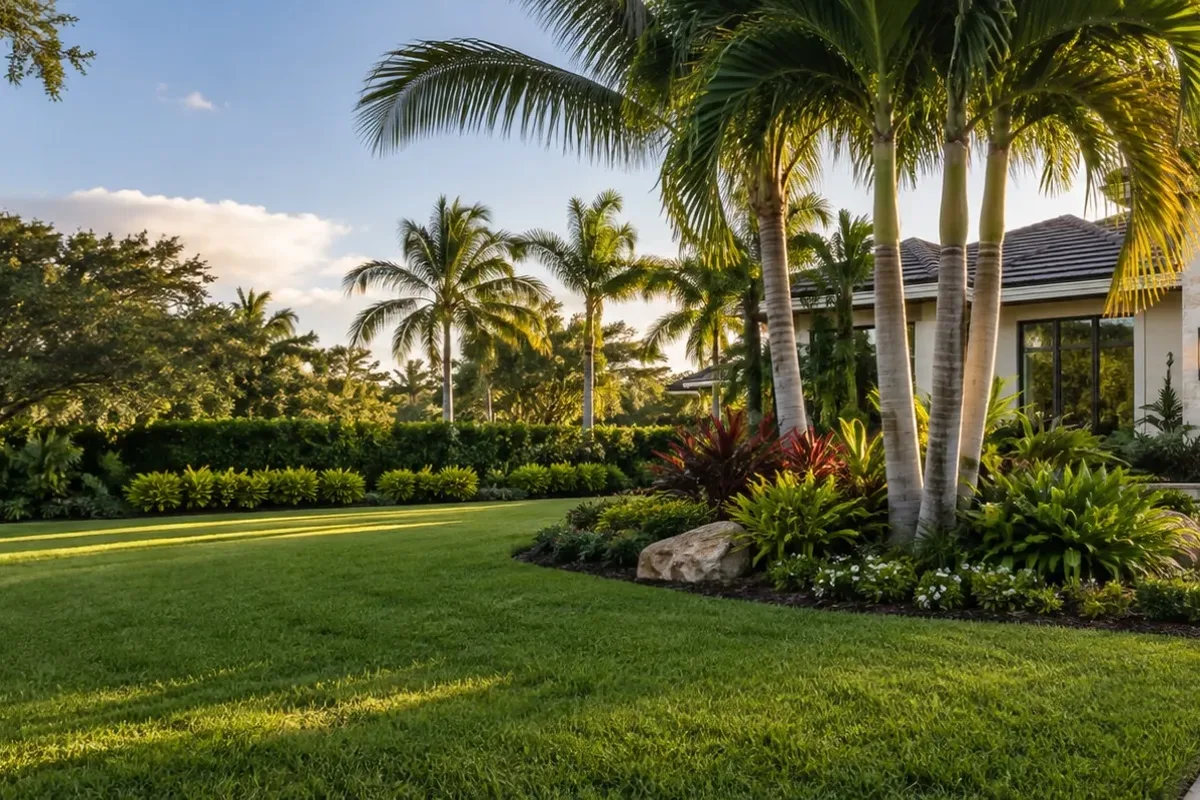
Dry-season lawn watering in Broward County starts with a simple shift: from November through April, rain stops doing most of the work. Afternoon storms taper off, cold fronts bring the occasional soaking, and long dry stretches become normal. A lawn that looked fine in September can thin out by February if the irrigation plan never changed.
The fix is rarely more water. It is the right amount, on the allowed days, at the right time of morning, delivered evenly across each zone. University of Florida IFAS guidance and the South Florida Water Management District rules point in the same direction, and following both keeps turf healthier while keeping a property within local ordinances.
Earthly Exteriors, based in Southwest Ranches, provides lawn care, landscaping, pavers, and tree services across South Florida. The broader company overview is on the Earthly Exteriors homepage.
This guide covers the watering rules that apply year-round, how to tell when a lawn actually needs water, and how mowing and bed care support turf through the dry months.
Broward Watering Rules Apply All Year
The South Florida Water Management District enforces year-round landscape irrigation restrictions under Chapter 40E-24 of the Florida Administrative Code. The core rule is consistent: no landscape irrigation between 10 a.m. and 4 p.m., and watering limited to set days. The rule covers all water sources, including utility water, private wells, and ponds or canals.
In Broward County, including Southwest Ranches and Davie, odd-numbered addresses may water on Wednesdays and Saturdays, and even-numbered addresses on Thursdays and Sundays. Allowed hours run from midnight to 10 a.m. and from 4 p.m. to 11:59 p.m. Hand watering with a hose fitted with a self-cancelling nozzle is permitted under the district rule, though some cities limit how long it can run.
New landscaping is treated differently. Local ordinances, including Southwest Ranches', allow extra watering days during an establishment period after new sod or plants go in. Rules can change when drought conditions tighten, so homeowners should confirm current days on the SFWMD landscape irrigation page or with their city.
Let the Lawn Signal When It Needs Water
Having two legal watering days does not mean both must be used. UF/IFAS recommends letting the lawn show when it needs water. The three signs of thirst are leaf blades folding lengthwise, a blue-gray tint, and footprints or tire tracks that stay visible instead of springing back.
UF/IFAS suggests irrigating when roughly 30 to 50 percent of the lawn shows at least one of those signs, unless rain is forecast within 24 hours. Watering on demand rather than on a fixed calendar encourages deeper roots, and deeper roots are what carry turf through a dry February.
Cooler temperatures and shorter days also reduce how much water turf uses compared to midsummer. Many lawns that needed every allowed day in August can go longer between waterings in December. Watching the grass, rather than the controller, is the more reliable guide.
Apply the Right Amount in Each Zone
When the lawn does need water, UF/IFAS recommends applying 1/2 to 3/4 inch per irrigation. South Florida’s sandy soils often need the 3/4-inch rate. Where hard limestone sits close to the surface, less may be enough, since roots cannot grow past that layer anyway. Water applied past the point of runoff is wasted and can carry lawn chemicals into storm drains.
Run times differ by zone because spray heads and rotors apply water at very different rates. UF/IFAS notes that spray zones need roughly a quarter of the time that rotor zones do, and that run times should rarely exceed 20 minutes for spray heads or 60 minutes for rotors.
- Set straight-sided cans, such as tuna or coffee cans, across one zone.
- Run the zone and time how long the cans take to reach 1/2 to 3/4 inch.
- Uneven fill levels point to clogged, tilted, or blocked heads.
- Repeat for each zone and set the controller to match.
Early morning is the most efficient window. Watering before sunrise lets water soak into the root zone before heat and wind increase evaporation, and it stays inside Broward’s allowed hours.
Rain Sensors and Controller Settings Matter
Florida has required rain sensors on new automatic irrigation systems since 1991, and UF/IFAS stresses that they should stay functional. A working sensor skips a scheduled cycle after a meaningful rain, which matters during the cold-front soakings that interrupt the dry season.
UF/IFAS recommends setting the sensor to shut off irrigation after 1/2 to 3/4 inch of rain, mounting it with open sky above, and testing it quarterly outside the rainy season. A quick test is to spray the sensor while the system is running; the zones should stop soon after. A sensor hidden under an eave or a palm canopy may never register rain at all.
November is also a practical time to review the whole controller schedule. Settings carried over from summer often run too long and too often for the season, which wastes water and invites problems in shaded or low areas of the yard.
Mowing and Beds Support a Drier Lawn
Irrigation is only part of dry-season care. UF/IFAS recommends mowing at the highest recommended height for the grass type: 3.5 to 4 inches for standard St. Augustinegrass cultivars, 2 to 2.5 inches for semidwarf cultivars, and 3.5 to 4 inches for bahiagrass. Taller grass shades the soil and supports deeper roots.
No more than one-third of the leaf blade should be removed at one mowing, and blades should stay sharp so they cut cleanly instead of tearing. Grass grows more slowly in the dry months, so mowing frequency usually drops as well. Scalped edges along driveways and sidewalks are often the first areas to brown.
Landscape beds benefit from the same attention. Two to three inches of mulch around shrubs and tropical plantings slows evaporation, and native plants generally need less supplemental water once they are established. Beds refreshed before the driest months hold moisture better through spring.
Drought Stress or Something Else
Not every brown patch in a dry month is a watering problem. UF/IFAS identifies the southern chinch bug as the most damaging insect pest of Florida turfgrass, and it can feed year-round in South Florida. Its damage first appears as yellow to brown patches in water-stressed or full-sun turf, which is why it is often mistaken for drought.
The difference shows after a proper watering. Drought-stressed grass usually recovers within days once coverage is corrected. Turf that keeps declining despite adequate water may have insects, disease, or another cause and should be inspected before more water or product is applied. Adding water to a pest problem only delays the real fix.
A Practical Standard for Dry-Season Care
Dry-season lawn watering in Broward County is less about running sprinklers on every allowed day and more about matching water to what the lawn shows. Following the two-day schedule, watering early, applying 1/2 to 3/4 inch evenly, and keeping the rain sensor working covers most of what turf needs from November through April.
Mowing high, refreshing mulch, and checking stubborn brown patches before reaching for the hose complete the plan. For homeowners who want help with mowing, edging, bed cleanup, or a landscape refresh this season, Earthly Exteriors offers free estimates by phone at (786) 285-3191 or by email at info@earthlyexteriors.com.