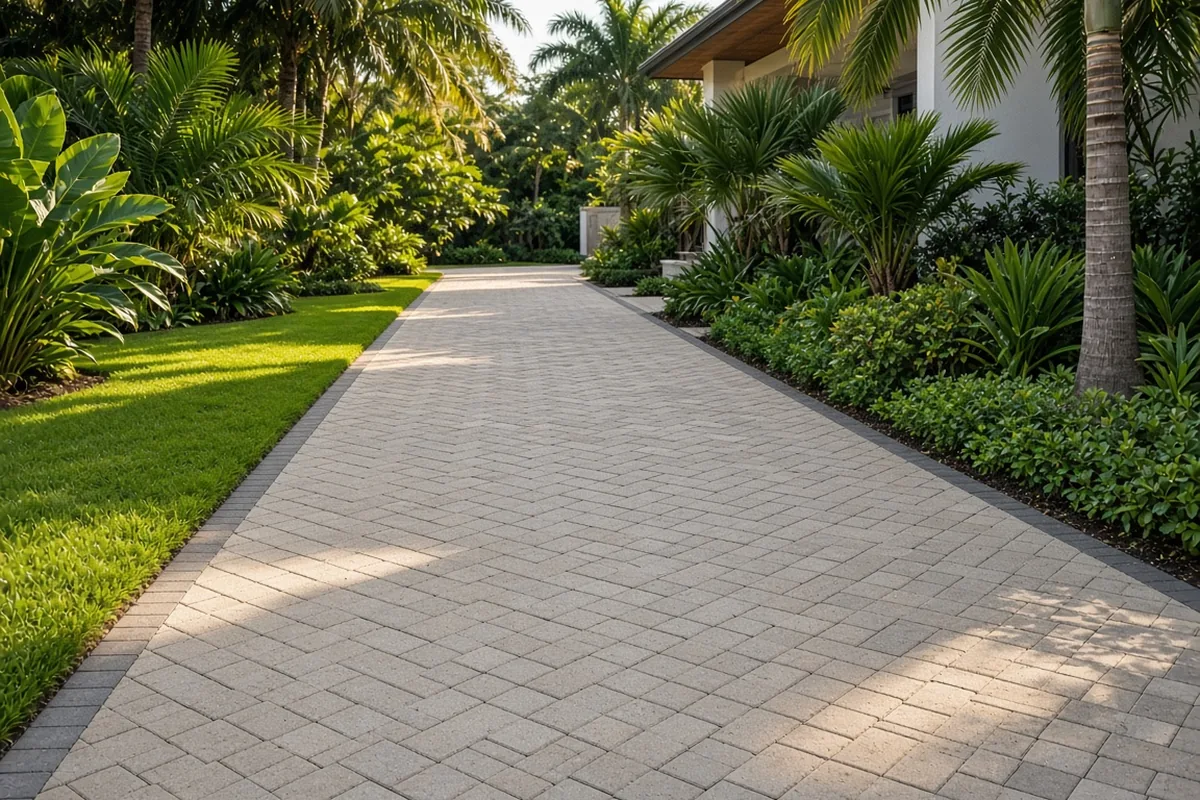
Paver driveways for South Florida homes are not only a surface choice. Color and pattern matter, but drainage direction, base preparation, edge restraint, and how the hardscape meets lawn and plant beds decide whether the entrance still looks true after a rainy season. For homeowners comparing options, the useful starting point is not a showroom sample, but a clear driveway brief: length, width, vehicle loads, and where water must go.
Earthly Exteriors, based in Southwest Ranches, includes paver driveway installation, walkways and garden paths, driveway repairs and refreshes, and clean edging among its hardscape services, alongside lawn care, landscaping, and tree work. That mix matters because a driveway rarely succeeds as an isolated slab. Bed edges, irrigation lines, and neighboring planting all affect the finished approach.
Service details are outlined on the Earthly Exteriors services brochure, with the broader company overview on the Earthly Exteriors homepage.
South Florida properties deal with intense storms, sandy or fill soils, and long stretches of heat that bake open pavement. A driveway has one primary outdoor job: carry vehicles cleanly while shedding water away from the house and garage. Interlocking pavers are often selected for that job when a refined, repairable surface is the goal.
Drainage Planning Comes Before Pattern Choice
Water that ponds at a garage threshold or along a low edge is a planning failure, not a cleaning problem. Grading should send runoff away from structures toward an intended outlet that already fits the lot. Flat South Florida sites often need that fall designed deliberately rather than assumed from a brochure photo.
Joints between pavers can help break up sheet flow compared with a sealed slab, but they do not replace slope. Homeowners who pick a pattern first and ask about drainage later often discover that the nicest color still sits in a puddle after summer storms. Existing swales, street aprons, and neighbor grades constrain what is possible.
A site walk that notes where water already goes after rain is more useful than a photo of a finished driveway from another neighborhood. Low spots that hold water in the lawn today will still matter after the pavers are set, unless grading changes the path.
Base and Edges Carry the Load the Surface Advertises
Pavers are the wearing course. The compacted base beneath them spreads vehicle weight into the ground. Weak or uneven support shows up later as dips, rocking units, and edge failure, especially where cars turn or brake. South Florida sand can drain well, but it still needs proper compaction and separation from migrating fines.
Edge restraint keeps the field from spreading. Clean edging where pavers meet lawn or beds also protects the hardscape from turf creep and makes routine mowing simpler. Driveway repairs and refreshes on the brochure exist because older installs sometimes need localized reset rather than a full tear-out.
Boat trailers, RVs, and heavy delivery traffic change the conversation. Load expectations belong in the same planning pass as color and layout. Underestimating use is a common reason a residential pattern fails early at turning radii, even when the center of the driveway still looks fine.
Match the Driveway to the Property Question
A useful comparison asks what the entrance must do every day and what it must survive in storm season. If the objective is a durable interlocking surface with clean edges and local install support, pavers through a landscaping and hardscape crew are a direct match. If the objective is only a temporary patch over failing asphalt, a limited repair may be enough until a full replacement is scoped.
Many South Florida properties combine driveway work with walkways, garden paths, and bed renovations so the arrival sequence feels continuous. The brochure also lists landscape planning, tropical and native plant selection, fresh mulch, and decorative stone, which lets hardscape sit inside a wider curb-appeal plan rather than as a lone rectangle of stone.
Asking for pavers alone without edge detailing, drainage notes, or plant-bed coordination often produces a weaker entrance than a scoped project. The surface is one component. The grade and borders are the others. Homeowners who skip that integration usually pay for a second bed or edge pass within a year.
Installation Sequence Protects Both Hardscape and Plants
A clean paver install is less about guessing product performance and more about basics done carefully: excavation to the right depth, a stable compacted base, correct bedding, consistent jointing, and edges that hold. Access for equipment should be planned so newly planted beds are not crushed afterward.
- Confirm driveway dimensions, apron constraints, and preferred pattern before materials are ordered.
- Plan where water will exit the pad after storms, including garage thresholds.
- Coordinate lawn care and planting so edges and irrigation heads are set after hardscape locks in.
- Fold walkway or garden-path work into the same layout when the entrance needs a complete refresh.
Earthly Exteriors lists lawn care and landscaping on the same menu, which pairs naturally with a new driveway. Tree trimming and removal matter when canopy roots or falling fronds would damage a fresh surface or block equipment access during install.
Repairs and refreshes deserve the same honesty. Localized settling can often be corrected by lifting and rebedding units if the base is still sound. Widespread failure usually points back to drainage or base issues that a surface-only cosmetic pass will not fix. Knowing which problem is present saves replacing a driveway that only needed a section reset.
Landscape Integration Keeps the Entrance Coherent
Clean edging and landscape integration appear alongside paver installation on the brochure. Installing hardscape and planting in the wrong order can mean redoing bed lines or driving equipment across new turf. Homeowners planning both a driveway update and a front-yard refresh should sequence the work so soil, edges, and access routes support what remains.
Mulch and decorative stone can finish the beds after the hardscape line is locked, which keeps material from spilling into joints during construction. Irrigation adjustments after excavation are equally common and should be budgeted as part of the project rather than discovered on the first dry week.
Estimates are listed as free. The company invites property discussions by phone at (786) 285-3191 or email at info@earthlyexteriors.com. Pricing depends on square footage, pattern complexity, site access, grading needs, and whether walkways, repairs, or planting are included.
A clear scope makes that estimate more accurate: measured length and width, notes on drainage, vehicle types, and any fence or planting work already planned. Vague requests produce vague numbers. Local crews familiar with South Florida conditions can also flag when a proposed layout conflicts with utility easements, irrigation mains, or tree roots.
A Practical Standard for Driveway Hardscape
Paver driveways are a South Florida entrance tool with local installation support, not a universal substitute for every pavement problem. The strongest project plan sets drainage first, builds a stable base and edge system, and treats planting and lawn edges as part of the same arrival sequence.
For homeowners comparing options, start with how water moves across the lot and what vehicles the driveway must carry, then decide whether paver installation should be paired with walkways, bed renovations, tree work, or ongoing lawn care on the same timeline. Clear scope up front makes the free estimate more useful and keeps the finished entrance aligned with how the property is actually used.